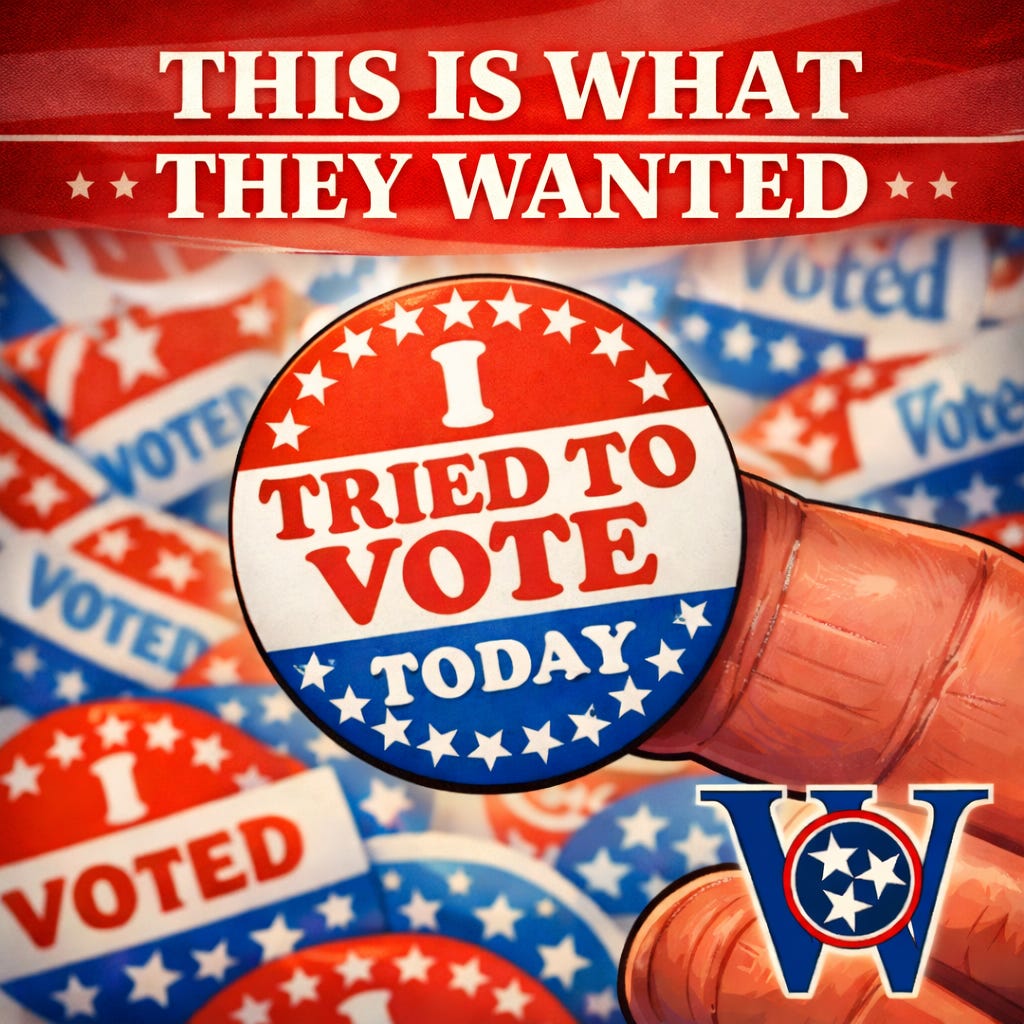
🪑 THIS IS WHAT THEY WANTED
Last Saturday, Maury County Republicans gathered at The Well Church in Columbia to select their nominees for county offices and school board. According to the Columbia Daily Herald, the caucus “drew nearly 500” bona fide Republicans — a headline that reads like a triumph… if you didn’t know the county has roughly 70,000 registered voters.
So let’s slow this down.
In Maury, a solidly red county, the universe of “bona fide Republicans” eligible to vote in a caucus sits just north of 6,000. Even if we accept the “nearly 500” figure at face value — and we’ll address that — we are talking about single-digit percentage participation among eligible Republican voters, on a Saturday, at a single location.
Now consider what actually decided the races.
County Commission District 11 produced 36 ballots — a tie with 18 people on each side. District 7 saw 62 ballots cast. The margin between first and second place? One vote. District 5 came in with ninety-two ballots and a twelve-vote spread. District 9 required 107 ballots to determine its nominee, while School Board District 9 was decided by 44 ballots.
These are the nominee totals in a county where a Republican will almost certainly prevail in November. HOA elections draw higher tallies.
If you sum the ballots cast, you arrive at 451 recorded votes, per the official results sheet. That figure represents cumulative ballots across the contested races, without considering voter duplication.
So what exactly is “nearly 500?”
Sign-ins? Volunteers? People waiting in cars? Church-goers who got their days mixed up?
Perhaps it’s defensible. Maybe it’s generous. What it clearly is not is 500 ballots — not even close.
And none of this is accidental.
Last year, during the legislative fight in Nashville over whether counties would be required to use traditional primaries for local offices, the argument from certain party leaders was that open primaries allow crossover voting — that Democrats were “meddling.” Williamson County Republican Party Chair Steve Hickey warned about “Democrats voting in Republican primaries.” Gary Humble of Tennessee Stands (and recent state senate candidate) assured everyone that “Caucus is not a dirty word.”
Other GOP officers echoed the message. “Don’t Democrat My Republican Primaries.” Self-styled “RINO hunter” journalist, Kelly Jackson, amplified the claim that the General Assembly had ultimately “stripped local Republican parties of their right” to choose candidates through caucuses or conventions. And not to be outdone, state-office-seeking ally Michelle Foreman sang from the very same hymnal.
Bad news for all of them: Maury County just ran the experiment.
When you shrink the electorate to a single building on a single Saturday under party rules, participation contracts. People stay home. Not because voters are indifferent, but because the door got narrower. A county with roughly 6,000 eligible bona fide Republican voters ends up with nominees crowned by a handful of ballots. The promise is grassroots engagement; the reality is a small room deciding the county’s future.
Williamson County, take note. This is precisely the model some local “grassroots” candidates fought to preserve. County Commissioner and mayoral candidate Mary Smith aligned with the caucus crowd. Commissioners Lisa Hayes, Chris Richards, and Bill Petty operated in that same orbit. School Board candidate Elliott Franklin ran as part of the slate defending that structure. And Marlin Jackson — largely unknown (and Kelly’s better half) — is now running for County Commission as well. The candidates who fought to narrow the electorate are now asking you to show up in it. Participation appears to be valuable again.
Now, if any of the aforementioned candidates believe they have been mischaracterized as defenders of the caucus model, the invitation stands. Say it plainly. State publicly that you do not support caucuses — not now, not ever — and that you believe nominations should be decided in accessible primaries. Voters would welcome the clarification — perhaps demand it.
Strip away the slogans. Strip away the warnings about “meddling.” What’s left is turnout.
They argued this was about integrity. Maury demonstrates that it is about scale.
This is what they wanted.