

🗞️THE DUMP – June 20, 2025🗞️
Your Weekly Look at the Weird, the Wild and Williamson County
Welcome back to The Dump—your weekly look at the weird, the wild, and Williamson County.
This week, SCOTUS just told Tennessee: you were right. They were wrong. Sheriff Hughes wants a raise and a Wagoneer. Two county commissioners found a procedural trapdoor and fell right through it—dragging the whole Commission with them.
The school board fumbled phones, tests, and a half-baked budget. And also—a look back at legislators who wanted to pave roads with pot smoke.
Strap in, folks. Let’s dump it out.
⚖️SCOTUS TO TENNESSEE: YOU WERE RIGHT. THEY WERE WRONG.
Big news out of Washington this week—and for once, it’s not about Trump, aliens, or Joe Biden walking into a flagpole.
On Wednesday, June 18, the U.S. Supreme Court handed down a 6–3 decision in United States v. Skrmetti, upholding Tennessee’s 2023 ban on medical gender transition procedures for minors. The ruling affirms what many in Tennessee have been saying for years: children are not test subjects, and states have every right to protect them from irreversible medical interventions dressed up as identity.
Yes, it’s true. Minors still need parental permission to get their ears pierced in Tennessee. But until this law, a child could be chemically sterilized by age 15—as long as someone somewhere thought it might improve their self-image.
It Started at Vanderbilt
Back in 2022, Vanderbilt University Medical Center was allegedly operating a pediatric gender clinic where minors could receive cross-sex hormones, puberty blockers, and—in some cases—surgical referrals. No public debate, no transparency, and definitely no billboard downtown. Just one of the state’s top hospitals moonlighting as a permanent identity factory.
Then came The Daily Wire’s Matt Walsh—armed with screenshots, footage, and what looked like half of his wardrobe from Party City. Wig, hidden camera, moral indignation—you name it. But credit where it’s due: he blew the doors off the story and forced everyone to look.
The outrage was immediate. Tennesseans didn’t blink when kids dyed their hair blue. But permanent chest reconstruction before high school graduation? That was a hard no.
Strategy Over Screaming
Early legislative efforts—like the Ragan-Bowling bill—had the right instincts but the wrong legal strategy. It was essentially Tennessee’s version of the Arkansas SAFE Act, a bill destined to crumble in federal court. It never stood a chance.
Some folks demanded immediate action. Others decided to craft a law that would actually survive.
Enter Senator Jack Johnson and House Majority Leader William Lamberth, who didn’t posture—when the legislature reconvened, they legislated out the gate. The bill was specific, defensible, and built to last. It banned gender transition procedures for minors, while still allowing the same treatments for legitimate medical needs like precocious puberty, cancer, or hormonal disorders.
The brilliance of the law? It targeted purpose, not medication.
You can treat a pituitary issue—but you can’t inject testosterone into a 14-year-old girl because she thinks her name might be Bryce now. Sorry.
And it came with real teeth: civil penalties, attorney general enforcement, private lawsuits, and license revocation. In other words: an actual law—not a mere scolding in legislative clothing.
The Courtroom and the Clapback
Predictably, lawsuits followed. So did the Biden administration, because nothing says federal priority like D.C. lawyers trying to override Tennessee parents and doctors.
But Tennessee’s Attorney General Jonathan Skrmetti was ready. No theatrics, no grandstanding—just a clean, relentless legal case. And he ultimately won… at the U.S. Supreme Court.
Chief Justice John Roberts, writing for the majority, said the law was based on age and medical use, not sex or identity. The court applied rational basis review, which in plain English means: “This is your state, your rules, and your reasoning checks out.”
Justice Sotomayor dissented, calling it a “tragic day for transgender youth.” Others might call it a really good day for common sense.
The Fallout
Tennessee’s leadership didn’t just celebrate—they stood vindicated.
• Jack Johnson: legislative win
• William Lamberth: policy confirmed
• Bill Lee: right call
• Jonathan Skrmetti: undefeated
The outrage machine kicked in: “Political!” “Dangerous!” “Slippery slope!”
Maybe—or perhaps—it’s the end of handing Schedule III drugs to middle schoolers because a lab coat said “affirming.”
Most critics? ChatGPT lawyers and TikTok paralegals are still waiting for the next slippery slope—right after they finish watching Judge Judy—Season 196.
WW BOTTOM LINE
Tennessee stood its ground. And the Supreme Court stood with it.
No one’s criminalizing pronouns. But the law now says this: if you’re under 18, you’re not making permanent medical decisions that you might regret before you can legally buy a scratch-off ticket, rent a car, or get a tattoo.
So for the folks still worried about freedom? Relax.
You can still take your teen to get a nose piercing. You just can’t amputate their reproductive organs and call it “care.”
Seems reasonable.
🚓 SHERIFF HUGHES RE-ENGAGES BUDGET DISCUSSION ON DEPUTY PAY, FLEET UPGRADES
Earlier this month, Sheriff Jeff Hughes returned to the Williamson County Budget Committee to renew his call for increased deputy compensation, citing growing recruitment challenges and retention risks as neighboring law enforcement agencies offer higher starting pay.
Hughes appeared alongside a large contingent of uniformed deputies and told the committee that while the county approved 9 of the 19 new positions he requested earlier this year, funding new positions alone won’t keep the department competitive.
“Public safety isn’t luck—it’s sacrifice,” Hughes said.
“How can the Williamson County Sheriff’s Office expect to recruit and retain quality employees when our compensation is significantly lower than neighboring law enforcement agencies?”
The proposed FY 2025–26 county budget totals $904,217,990, including $174,079,520 for the County General Fund. Hughes warned that current allocations don’t address pay compression and won’t prevent experienced deputies from leaving.
We’ve pivoted from not enough staff to staff is underpaid.
Meanwhile, the sheriff’s office is also upgrading its vehicle fleet. Sources confirm the department is requesting Chevrolet Tahoes and Jeep Wagoneers, marking a shift away from standard-issue Ford Explorers.
The full County Commission is expected to vote on the budget on Friday, June 20 at 9:00 a.m.
🧨 WW BOTTOM LINE
Sheriff Hughes is absolutely right to say public safety requires sacrifice. The question is: whose?
Let’s walk through the sequence of this oddly timed request:
Ask for more deputies. (We’re critically understaffed!)
Complain you can’t afford the ones you’ve got. (They’re underpaid and leaving!)
Then upgrade the fleet to Wagoneers with luxury trim. (Morale comes with massaging seats, right?)
Nothing says “fiscal restraint” like leather seats with lumbar support on patrol. The teachers can keep sharing broken copy machines.
So next time you're told the county “can’t afford” a raise for the people fixing potholes or a new counselor for your kid’s school, just ask:
“Is that before or after we finish paying off the Wagoneers?”
🧾 STOP-LOSS, START NONSENSE: HOW TWO COUNTY COMMISSIONERS TURNED GOVERNANCE INTO A CLOWNSHOW
Last week, we told you about the sudden stall in the County’s stop-loss insurance renewal. This week, we’re setting the record straight—with facts, a correction, and a full breakdown of how two commissioners used a technicality to throw a wrench into county operations.
🧠 HERE’S WHAT REALLY HAPPENED:
Williamson County needs to renew its stop-loss insurance—the policy that protects taxpayers from catastrophic health claims. The new contract was filed late on June 5, just five days before the June 10 Commission meeting.
Because of that timing, the resolution was classified as a late-filed item. And under Commission rules, that triggers a specific parliamentary shortcut: a late-filed item can be tabled—not debated, not amended, not considered—with nothing more than a motion and a second. No justification. No discussion. Just two people saying “not today,” like it was yoga class and not government.
County Commissioners Chris Richards and Lisa Hayes knew exactly what they were doing. They didn’t just spot a procedural gap—they exploited it.
There had been a public committee meeting in advance of the vote—a clear opportunity to ask questions or raise concerns. They didn’t attend. Further, they made no request for additional information and no motion to defer. Then, when the resolution reached the floor, Hayes moved to shut it down, and that was that.
What followed was predictable: a round of finger-pointing, complaints about transparency, and a viral claim that the contract totaled $90 million—a number that’s not just wrong, it’s wildly misleading.
The actual contract is for $4 million—a standard renewal of the County’s existing stop-loss policy. The $90 million figure represents the County’s full health insurance fund. That number has nothing to do with this vote.
And while they posture about procedure, there’s real exposure on the line. If this doesn’t pass by June 30, the County could be on the hook for up to $2.5 million in uninsured risk.
To clean up the mess, Mayor Rogers Anderson has now called a special meeting at 8:00 a.m. on Friday, June 20, forcing all 22 commissioners to come in early to fix a mess that never needed making. Not because of new facts. Not because of public pressure. But because two commissioners decided to score points instead of show up.
Let’s not kid ourselves—this contract will pass. It always was going to. Because it’s not controversial. It’s not poorly written. And it’s not financially reckless.
It’s just late. And in their hands, late was enough.
💥 WW BOTTOM LINE
Richards and Hayes didn’t uncover a problem—they manufactured one. They saw an opportunity to do something dumb—and they didn’t miss.
They took a routine vote, skipped the meeting, ignored the details, inflated the number, and shut it down with a two-person procedural stunt. Then they turned around and blamed everyone else for the confusion.
Now, the rest of the Commission has to cancel plans and clock in early just to triage the drama. If there were stop-loss coverage for this kind of nonsense, they’d max out the policy by sunrise.
📚 CELL PHONES DOWN, TESTS UP, BUDGET SHRINKS: WCS TRIES DOING THREE THINGS AT ONCE
The Williamson County School Board met Monday night and—against all odds—got things done. No one stormed out, no one filibustered about grammar, and there was only one long detour into the neurological development of the teenage brain. That’s progress.
Here’s what they pulled off:
Cell phones are going dark… kind of.
The board passed a new phone policy 10–0. Starting July 1, kids in K–8 have to keep phones silenced and out of sight all day. High schoolers still get screen time at lunch—because nothing builds emotional resilience like scrolling Instagram in a fluorescent cafeteria.
A few board members wanted a total ban, but principals politely reminded them that someone has to enforce this, and maybe let’s not start riots in August.
So, for now: phones off during class, lunch is still lawless, and the “bell-to-bell” crackdown hit snooze. A parent-stacked committee is meeting in August, and by September, expect a full report on how many 16-year-olds survived 90 minutes without texting their mom about Chick-fil-A.
You can see the test, but you probably can’t take it again.
The board voted 8–2 to pass a policy that guarantees students and parents can access tests and quizzes. Straightforward, until it wasn’t. Things got philosophical fast: What even is a reassessment? Is it a pop quiz—a retake?
In the end, they stripped out the confusing part about “reteaching and reassessment” after some members worried it might morph into a district-wide do-over festival. Now, the policy just says teachers have to show you the test—but don’t get your hopes up about getting a second swing at that mitochondria question.
Surprise! There’s a budget meeting this Friday.
The board will reconvene this Friday at 5 p.m. for a special-called budget meeting, because the County Commission is voting Friday morning and someone’s going to have to make the math work by dinner.
There are already expected cuts (hello, cheaper insurance), and board members were warned: miss this vote, and you risk starting the fiscal year without a budget. Or worse—needing another meeting.
If you thought your kid’s backpack was heavy, wait until you see the spreadsheets flying between 9 a.m. and 5 p.m. Friday.
📉 WW Bottom Line
Phones? Sort of banned.
Tests? Kind of transparent.
Budget? Lightly toasted.
We’ll call it a win.
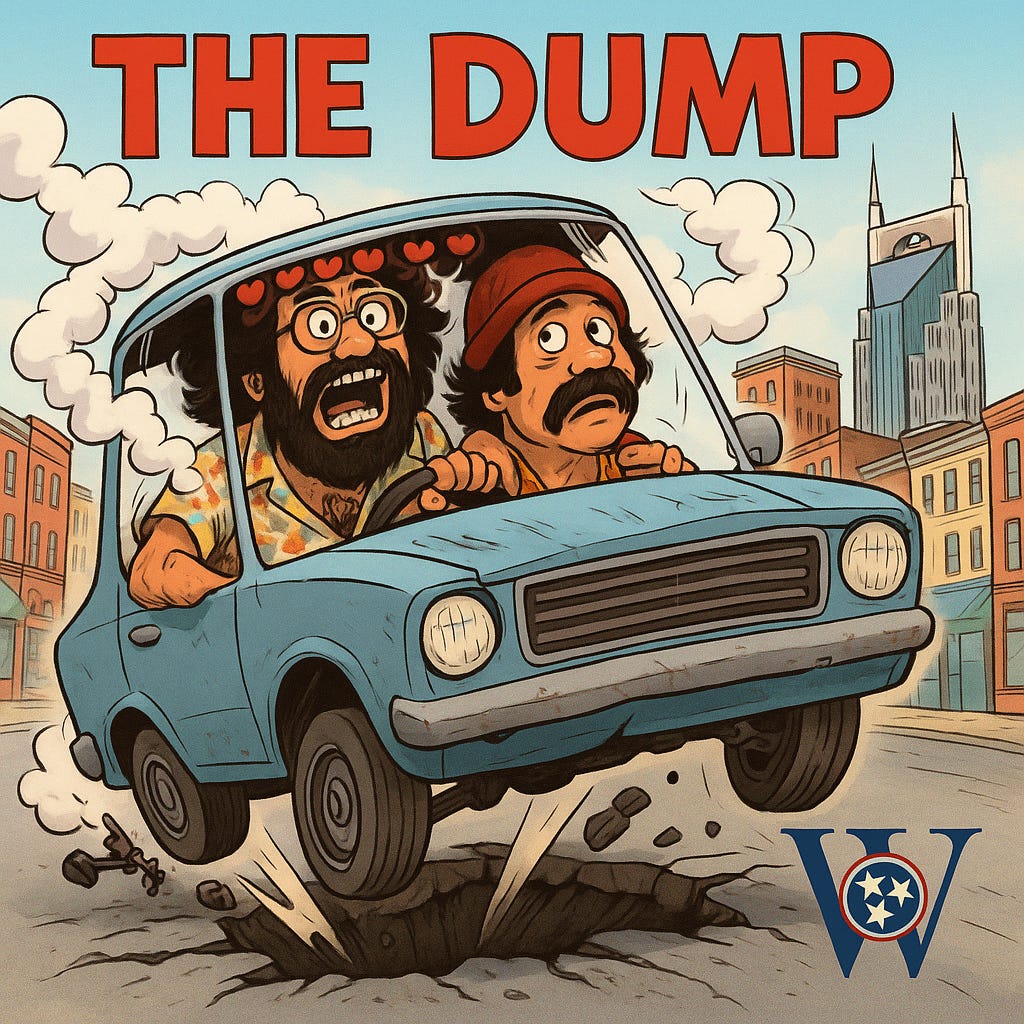
🧻 FINAL FLUSH: PUFF PUFF PATCH: THE “POT FOR POTHOLES” ACT EXPLAINS EVERYTHING WRONG WITH TENNESSEE INFRASTRUCTURE POLICY
Ladies and gentlemen of Tennessee—do you ever feel like the government is gaslighting you?
We’ve been thinking about Wednesday’s Dummy of the Week. (Yes, Sen. Heidi Campbell earned it. No, we’re not sorry.) But that whole Pot for Potholes thing? It deserves to be aired out. And let’s be honest—it’s kind of hilarious. You’d have to be high to think it makes sense: legalizing weed is our last hope for fixing the roads.
That’s right. Sen. Campbell and Rep. Aftyn Behn—two proud progressives from Nashville—introduced a bill earlier this year called the “Pot for Potholes Act.” A plan so dazed and confused, it should come with a Pink Floyd vinyl and a microwaved 7-Eleven pizza.
To review, here’s the pitch:
Let’s legalize recreational marijuana and use the 15% sales tax to fund road repairs.
Why? Because nothing screams responsible infrastructure policy like funding DUI traps with THC sales.
But here’s the buzzkill:
We already pay for the roads. You’re just too sober to notice.
Let’s take a spin through Taxation Nation™, shall we?
🚗 Buy a car?
• 7% state sales tax — good, fine
• 2.75% local tax (first $1,600) — okay, sure
• 2.75% single article tax — alright, enough
• $13 title fee — are you kidding?
• $29 registration — for the privilege of existing
• $50–$66 wheel tax — because you have wheels
• $30 city tax — because you live somewhere
• $11 lien fee — financed it? That’s extra
• $71 plate fee — want flair? Pay up
⛽ Fill 'er up?
• 26¢ state gas tax — fine
• 18.4¢ federal gas tax — whatever
• Special petroleum fee — because screw you
🔌 Drive electric?
• $100 EV fee — for not buying gas like a proper citizen
And you thought the toll booths were bad.
Tennessee already spends nearly $1 billion just on resurfacing. In 2025, they threw in another billion from the General Fund. Plus $80 million in recurring money, federal aid, tire taxes, and more.
And somehow—somehow—we still need to legalize pot to patch a pothole?
• Driving high? Illegal.
• Driving over potholes? Inevitable.
• Fixing roads with high taxes on high people? Welcome to Tennessee, baby!
This is what happens when elected officials don’t want to deal with budget accountability—so they hotbox a legislative fantasy and call it infrastructure reform.
Tennessee runs one of the most aggressive “user-pays” road systems in the country—if you drive, you’re already footing the bill. From vehicle sales to gas taxes to wheel fees, the cost lands squarely on the people actually using the roads—not some fuzzy pot of income tax, and definitely not a stoner surcharge on mood-altering gummies.
Maybe that’s the real plan.
Maybe if you’re high enough, the roads do feel smoother.
Maybe that crater on 8th Avenue is just a portal to enlightenment.
Maybe funding potholes with pot makes perfect sense—until you sober up and hit the axle-snapping truth.
So when your state senator lights one up and tells you this is the solution?
Just remember:
Inhale the policy.
Exhale the accountability.
🌀 That’s it, friends.
Another week of civic confusion, courtroom clarity, and taxpayer-funded chaos.
If the policy doesn’t make sense, the pothole probably will.
Stay safe. Stay sharp. Stay Wrong.
See you next week!
.