🗞️ THE DUMP — April 10, 2026
YOUR LOOK AT THE WEIRD, THE WILD AND WILLIAMSON COUNTY
Hey neighbors — welcome back.
It’s been one of those weeks where you start out thinking you’re just going to skim a few headlines and next thing you know you’re knee-deep in legislative fine print, campaign stagecraft, and a hospital conversation that suddenly isn’t as hypothetical as everyone keeps pretending it is.
We had dueling mayoral debates featuring the same candidates but completely different realities. Nashville quietly greased the rails for decisions nobody’s quite ready to say out loud yet. And one local forum canceled itself before anything even got off the ground. Somewhere in between, a couple of fast-growing towns found out that relief is coming.
So grab a cup and settle in. Let’s dump it out.
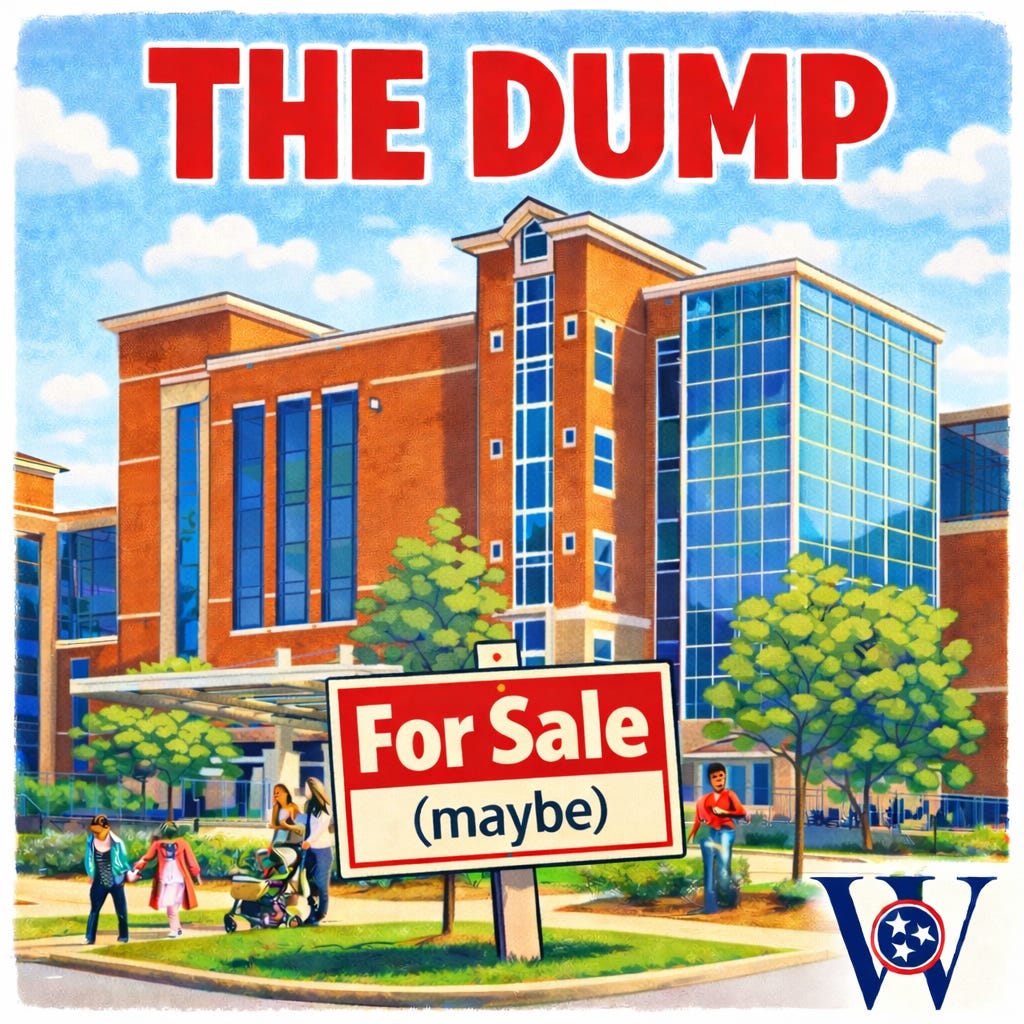
🏥 BEDS, BONDS & BUYOUTS: WHY THAT HOSPITAL QUESTION HIT THE STAGE
If you tuned into either Williamson County mayoral debate this week, you couldn’t miss the question that landed like a lead balloon: Would you ever sell the hospital?
Both candidates gave the same polished non-answer: “No. Not today. We need more information.”
Which is awfully ironic, because up in Nashville the Tennessee General Assembly just spent the last two months making it a whole lot easier to turn that “no” into a very lucrative “yes… with flexibility.”
Let’s connect the dots.
The bills — HB2646 and SB2194, sponsored by Rep. Jake McCalmon and Senate Majority Leader Jack Johnson — cleared both chambers this week and are now parked on the governor’s desk. The new law won’t sell the hospital. That decision still belongs to the County Commission, but it does rewrite the rules on what happens to the proceeds if a sale ever materializes.
Under the old rules, proceeds from a public hospital sale had to stay locked in healthcare uses — quaint stuff like actually helping sick people. But this legislation loosens the handcuffs and gives the County Commission broader authority to redirect those funds to… other priorities, like that tidy $1.1 billion in outstanding county debt that keeps compounding in the background.
McCalmon called it freeing the county from “outdated restrictions.” Johnson, for his part, praised the newfound “flexibility.” Flexibility — a curious word, here — the political equivalent of “we’ll decide later.”
But this isn’t new.
This didn’t magically appear on the debate stage this week. Nor did it begin with the bill filing in February. The overture started last November, when the Williamson County Commission passed Resolution 11-25-33, asking the legislature to tweak Tennessee Code so the money wouldn’t be so annoyingly tied to health care.
That same meeting, independent counsel Jesse Neil — a healthcare transaction specialist — was retained at $900 per hour. That’s not “let’s casually kick the tires” money. That’s “we’re hiring a getaway driver who knows every back road” money.
Meanwhile, over at Williamson Health, the board formed a special subcommittee and launched a formal RFP process to “explore strategic options,” including a potential sale. The public FAQ calls it the “discovery phase.” Discovery now comes with that $900-an-hour lawyer, custom legislation via Nashville, and both mayoral candidates fielding the same pointed question on stage… twice — all hypothetical, of course.
And here’s the kicker: nobody knows what the system is actually worth in today’s market. What are the hidden liabilities and legacy costs that will eat the first fat chunk of any sale price? How much actually goes to reduce that $1.1 billion debt versus just vanishing into “other priorities?”
If those spreadsheets exist, they’re apparently too shy to come out in public.
The conversation right now is fueled less by numbers and more by raw emotion — and that’s understandable. This isn’t some random widget factory. It’s the place where kids were born, parents had surgery, where the 2 a.m. emergencies were triaged, and lives were saved. You don’t just slap a “For Sale” sign on that without the community feeling it in their bones.
“We’re just exploring” is a wonderful phrase. It has a shelf life — right up until the moment the gavel falls, and suddenly it’s “the process is too far along now.”
WW BOTTOM LINE:
Nobody is signing closing papers on the hospital tomorrow. But the legal runway has been freshly paved, the high-priced professionals are already warmed up, and the questions are already being teed up at the lecturns.
The only thing still missing is the one thing that actually matters: transparent numbers and maybe a genuine public debate about what “flexibility” really means when the checks start clearing.
⚖️ PER DIEM DIARIES: FISCAL HAWK, HOUSE GUEST
You’re going to love this one.
Rep. Jody Barrett — it’s been a while. But he’s been busy carefully cultivating a reputation as the legislature’s resident fiscal hawk. You know the type. Votes against the big spending packages, wags his finger at voucher expansions, delivers the stern speeches about how somebody has to be the grown-up in the room when it comes to taxpayer dollars.
Great brand. Very marketable. Ten out of ten.
But there’s just one tiny problem.
Last year, Barrett collected roughly $25,600 in per diem payments. That’s the housing and travel money Nashville hands out to legislators who live far enough away to qualify. Perfectly legal. Plenty of reps take it.
But then, when other lawmakers floated the idea of tightening the radius rules so fewer legislators qualify for those per diem checks, Barrett suddenly transformed from Fiscal Hawk into Dove faster than you can say “direct deposit.”
No, Barrett argued. Let’s not mess with this. It’s about fairness. Access. Keeping things workable. (Sure, it is.)
Funny how “wasteful spending” turns into “essential support” when the check clears your account. So let’s translate Barrett’s position into plain English: “Cut spending. Not mine. Theirs.”
Now, no rules were broken. The per diem system is what it is. But there’s a difference between following the rules and fighting to make sure nobody ever changes them, especially when you’ve built your entire political identity on being the fiscal reformer.
All of a sudden, fiscal conservatism turns into fiscal convenience. Imagine that.
WW BOTTOM LINE:
The real tell in politics is never the vote on the big bill everyone’s watching. It’s the quiet fight over the small benefit nobody’s supposed to notice. That’s where you find out what people actually believe.
And right now, Rep. Barrett believes in cutting spending — mostly. Just not the kind that hits his mailbox.
🚧 PAVEMENT PROMISES: SPRING HILL & THOMPSON’S STATION GET THEIR TURN
Every now and then, the long game actually pays off.
This week, Spring Hill and Thompson’s Station are celebrating a long-awaited milestone — TDOT’s updated 10-year plan finally puts their road projects on the board.
Spring Hill Mayor Matt Fitterer called it “major news for our City.” Thompson’s Station Mayor Brian Stover called it “a meaningful step forward.” And to be fair, for two communities buried under growth and traffic for years… it is.
Now for the rest of the story.
Spring Hill gets I-65 widening from I-840 down to Saturn Parkway, with “design work starting soon” and construction “targeted” for 2028. Note the word targeted, though. In government-speak, that’s roughly equivalent to your teenager saying they’ll “probably” clean their room this weekend. (They won’t.)
Highway 31 is also still “on track.” On track for what, exactly? Nobody said. But it’s on track.
Up the road, Mayor Stover struck the requisite tone of cautious optimism, thanking residents for “speaking up” and assuring everyone that “the message is finally getting through to decision-makers.”
Both mayors deserve credit. They pushed. Residents pushed. And eventually, the bureaucratic glacier moved. That’s genuinely how it works, and the folks who showed up to meetings and made noise should feel good about that part.
Shovels aren’t in the ground yet — just a line on a planning document. And if you’ve ever witnessed a planning document meet reality, you know those two things don’t always travel together.
Still — it’s on the plan. Which, around here, is step one. Kudos to all!
WW BOTTOM LINE:
Two Tennessee towns got told their roads might get fixed sometime around 2028, and everyone acted like Christmas came early. Which tells you everything you need to know about how low the bar has gotten for government delivering basic infrastructure.
🎤 FORUM FIZZLE: NO SHOW, NO GO
The Williamson County Republican Party and Moms for Liberty Williamson County had a school board candidate forum all teed up for last Tuesday. Announced March 19. Venue booked. Flyers out. The whole nine yards.
Then — poof. Gone. Canceled the day before, event listing memory-holed, and the official explanation was that “several races weren’t contested.”
Uh-huh.
Here’s the problem with that. Those races were already set when they scheduled it. So that excuse has the structural integrity of a wet paper bag.
What actually happened is much simpler — and a lot more telling.
Nobody signed up.
From what’s been circulating, the only candidate who would’ve shown was Elliott Franklin — who is, conveniently, (checks notes…) the 2nd Vice Chair of the WCRP itself. Oof.
And honestly, can you blame the others? If you watched the recent WCRP mayoral forum — the questions, the crowd, the overall tone — you already know what kind of room that was. Most candidates took one look and made a business decision.
Naturally, the sunshine thieves over at Williamson Strong tried to spin this as a Moms for Liberty problem. Maybe that added some background chatter in certain circles… maybe.
But don’t overcomplicate it. This wasn’t about branding. It was about trust. Or more accurately — the lack of it.
WW BOTTOM LINE:
When candidates won’t even walk into the room, you don’t have a scheduling issue. You’ve got a credibility issue. And deleting the event page doesn’t fix that.
You can host all the forums you want — but if nobody trusts the stage, the chairs stay empty.
🌀 FINAL FLUSH: TWO DEBATES, ONE JOB — WHO ACTUALLY ASKED ABOUT IT?
And speaking of debates, let’s talk about what we saw this week. We watched both mayoral forums back-to-back — Monday’s WCRP debate and Wednesday’s Williamson Inc. forum — and walked away saying the same thing you probably did:
Those were two completely different experiences.
Same candidates. Same issues. Forty-eight hours apart. And yet it felt like two different races. Not because Mary Smith and Andy Marshall changed. Because the stages did.
Williamson Inc. told you exactly how the sausage was made before anyone opened their mouth. Three-person panel — the Williamson Herald, the Association of Realtors, the League of Women Voters — and a moderator who said it out loud: questions were developed and reviewed by all co-sponsors, not attributable to any individual group. (Neat.)
WCRP had two moderators, with no stated process or disclosure. Just — let’s get started. Here are the questions. (Well, alrighty then…)
Williamson Inc. came to find out how someone would govern. Budget trade-offs. Infrastructure priorities — name your top three and how you’d pay for them. Tax incentives, with actual county history baked in. Impact fees and workforce housing — arguably the most pressing quality-of-life issue in this county, and the only stage that bothered to ask about it.
The sharpest question of either night: would you increase revenue or reduce spending — which taxes or which services? No escape hatch. Just: pick one.
WCRP asked how you’d govern — but only after making sure you agreed with them first.
The debt question opened with “I’m sure you’d agree…” The transparency question started with “As Republicans, we all agree…” The smart cities question defined the entire concept before either candidate said a word.
That’s not asking a question. That’s handing someone a script and asking them to initial it. It became a pattern: load the topic with an opinion, frame the answer, then ask the candidate to confirm what you just told the audience to think.
Now — credit where it’s due.
WCRP’s campaign mailer segment was genuinely creative — quoting each candidate’s own marketing copy back at them and making them defend it. More forums should do that. And when both candidates gave the standard “it depends” dodge on the hospital sale, the moderator pushed back. That’s exactly what a moderator is supposed to do.
Williamson Inc., for all its strengths, didn’t allow follow-ups at all. And that felt like a miss. But those moments were the exception.
While Williamson Inc. was digging into tax incentives, impact fees, and whether candidates could actually define “strategic growth,” WCRP was spending time on smart city hypotheticals and intra-party unity questions.
And the crowds reflected it. Williamson Inc. was measured — behaved, even. WCRP had a laugh track — bursts of applause at the strangest moments, like an audience that wasn’t sure when to clap but figured they’d better.
If these two forums hadn’t landed 48 hours apart, maybe the contrast wouldn’t have been so sharp. But watching them back-to-back made it impossible to miss.
Both covered the same issues. Both gave the candidates a platform. But one stage was built to find out how someone would run a county. The other came in with opinions already formed and asked the candidates to agree with them.
One was a forum. The other was a filter.
And only one of those tells you who can actually do the job.
That’s the week, friends.
From “we’re just exploring” to “construction targeted for 2028,” the answers are usually somewhere between what’s said on stage and what’s already moving behind the scenes.
Appreciate you spending a few minutes sorting through it here.
Enjoy your weekend, keep your head on a swivel, and if anyone starts talking about “flexibility,” you might want to ask a follow-up or two.
We’ll do it again soon. Stay wrong.