

🌞 SUNSHINE, SHERIFFS, AND THE TAX-AND-SPEND WHACK-A-MOLE
There’s a rumor floating across Fairview — the kind that starts with “now I ain’t sayin’, I’m just sayin’.” And as rumors go, this one fits the pattern a little too neatly to shrug off.
If the whispers hold, the Fire and Police Chiefs have been holding a series of one-on-one meetings with City Commissioners — quiet drop-bys instead of open discussion — seeking an eighteen-percent raise for their own organizational structures and a nine-percent bump for all other city employees. Once both chiefs knock in stereo, the request mysteriously expands to the entire payroll. Fair or not, the math is blunt: the plan pencils out an annual property-tax hike of several hundred dollars for the average household.
If true, that’s a Sunshine Law problem masquerading as a friendly coffee meeting. Votes shouldn’t be stitched together in private, especially not while sidestepping the city manager. When talking about a major increase, you say it plainly — on the record, in a meeting, with the livestream catching every word. And if the argument can’t survive being spoken out loud in public, that’s usually the first sign it isn’t ready.
And if this déjà vu feels unusually strong, it’s because Williamson County has been watching the same pay-pressure storyline unfold at the county level — just with more zeros attached.
Sheriff Jeff Hughes has spent the better part of 2025 sounding the alarm that his department is being “starved.” And if you didn’t know better, you’d think the Commission had him working out of a garage with a slingshot and a broken stapler. But the budget tells a story that’s far less cinematic. In FY23, the Sheriff’s Office sat at roughly $27 million. By FY24 it had climbed past $32.4 million. FY25 pushed it into the $34.8 million range. And next year? $39.5 million.
If you’re counting at home, that’s over twelve million dollars of growth — meaning spending has effectively swollen by forty-six percent across three budget cycles. Had your salary grown at that pace, you’d be down at Percy Priest christening a boat named Knot Enough.
And this raises a question no one seems willing to ask out loud: How much is enough, Sheriff Hughes?
Before anyone works themselves into a lather about “not backing the blue,” let’s make something clear: our first responders deserve fair pay and the tools to do the job safely. And there’s a way this gets done. You show up with your A-game and your ledger — detailing population changes, crime trends, caseload pressure, agency comparisons, recruitment and retention patterns, exit surveys — the whole stack of inconvenient facts that either prove the case or don’t. And then you tell the public what outcomes will improve with that investment. Businesses do this every day. They call it justification. Government shouldn’t be allergic to the idea.
Which is why eyebrows shot up when, during Thanksgiving week, we watched a national spectacle unfold on The Shawn Ryan Show — a wildly successful podcast with a massive, loyal audience — where Ryan repeated secondhand claims to guest Tucker Carlson that the Williamson County Commission refused to fund law enforcement and to pay deputies competitively, despite being one of the wealthiest counties in the country. And then he detonated the conversation completely by saying, on air, that he “[f-bomb] hates” commissioners.
Needless to say, not one of Ryan’s finer moments. But to his immense credit, he walked it all back days later, saying, “I misunderstood what the sheriff was telling me.” The apology was sincere. Still, hearing the original segment felt a bit like being a kid and seeing KISS take their makeup off. It wasn’t the show anyone expected, and nobody felt better afterward.
But now that the dust has settled, let’s ask the obvious question: Which part was wrong?
Speaking to Carlson, Ryan said he talked to Hughes just “yesterday,” yet the salary increases were approved last June. The described timeline simply doesn’t square with the facts on the record. Nothing adds up. More importantly, this is how trust erodes and relationships sour — and government isn’t supposed to work this way.
And while we’re here, let’s talk about the version of the story that Ryan obviously did not hear. Back in January, Hughes insisted the headcount hadn’t moved since 2018. Now he has nineteen new positions. He said deputies weren’t paid in the 75th percentile. Now they are. He said the structure needed shoring up. Millions were added. And by June, when he returned for another increase, he arrived flanked by a full row of his own command staff — presented as support, sure, but it read to the room like budget negotiations had switched to formation drills.
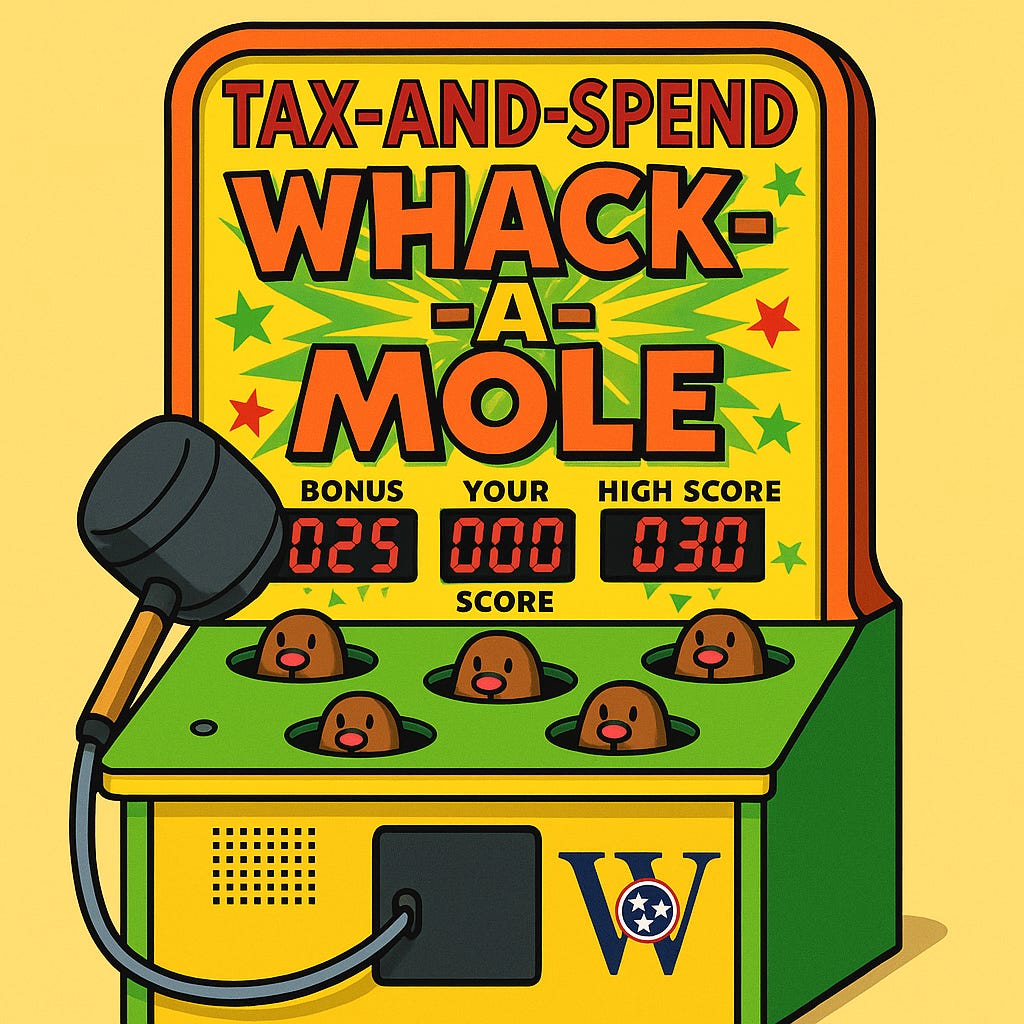
Sheriff Hughes — and this is said carefully — you’ve become the tax-and-spend sheriff.
You move through Republican events like a social fixture: handshakes, photos, shoulder squeezes — surrounded by the same people who rail against county debt like it’s an airborne virus. Yet somehow you believe you can ask for more money every few months, drive the debt upward while framing the Commission as stingy, and still be welcomed as one of the fiscal conservatives. Nothing says small-government Republican like asking for a budget that grows faster than the county’s population and then blaming everyone else when the bill shows up.
At some point, Sheriff, you have to pick a lane: either you’re the guardian of fiscal restraint or the guy shaking the cup every quarter. You can’t be both. If the county isn’t ballooning the debt, and you’re seeking more mid-cycle money, where do you expect it to come from?
Oh right — Commissioner Mary Smith had an idea.
Take it from the kids.
Smith once proposed raiding the education technology budget to help cover the Sheriff’s needs. It was such a staggeringly bad idea that you could almost hear printers warming up to spit out campaign mailers. “Give classrooms less so the Sheriff can have more.” Commissioner Smith, there are political missteps, and then there’s walking into traffic. If your solution to a funding problem is to rob the education budget, you might want to workshop that idea before you run for mayor.
What makes all of this worse is how little drama existed under the previous sheriff. He ran his shop without dragging the Commission into a fresh crisis every few weeks, and he didn’t stack command positions like he was outfitting his own personal battalion. He also wasn’t making the rounds through events blaming other elected officials for the basic responsibilities of running a department. Leadership seminars call that the “We/They” syndrome — the reflex to pin every problem on someone else. “Gee Bill, I’d love to give you a raise, but they won’t let me…” It’s the oldest managerial dodge in the book.
This budget circus is what happens when fiscal planning turns into whack-a-mole — with frantic swinging while the real problem keeps popping back up untouched.
So let’s zoom out.
Fairview, cut the backroom strolls. Make your case in the open, with the city manager in the seat where that authority belongs.
Sheriff Hughes, if you want more taxpayer money, show the evidence and show the finish line. And please stop selling the idea that the Commission has you on starvation rations when the budget looks like it’s been carb-loading for years.
We support our first responders, and we value the work they do. But this isn’t an endless budget, and municipalities and counties aren’t here to dispense money on command.
Budgets aren’t piñatas waiting for whichever department grabs the stick next. And sunshine isn’t always comfortable, but it’s how you see whether leaders are cracking open real solutions — or just taking another swing because they think it’s their turn.
.