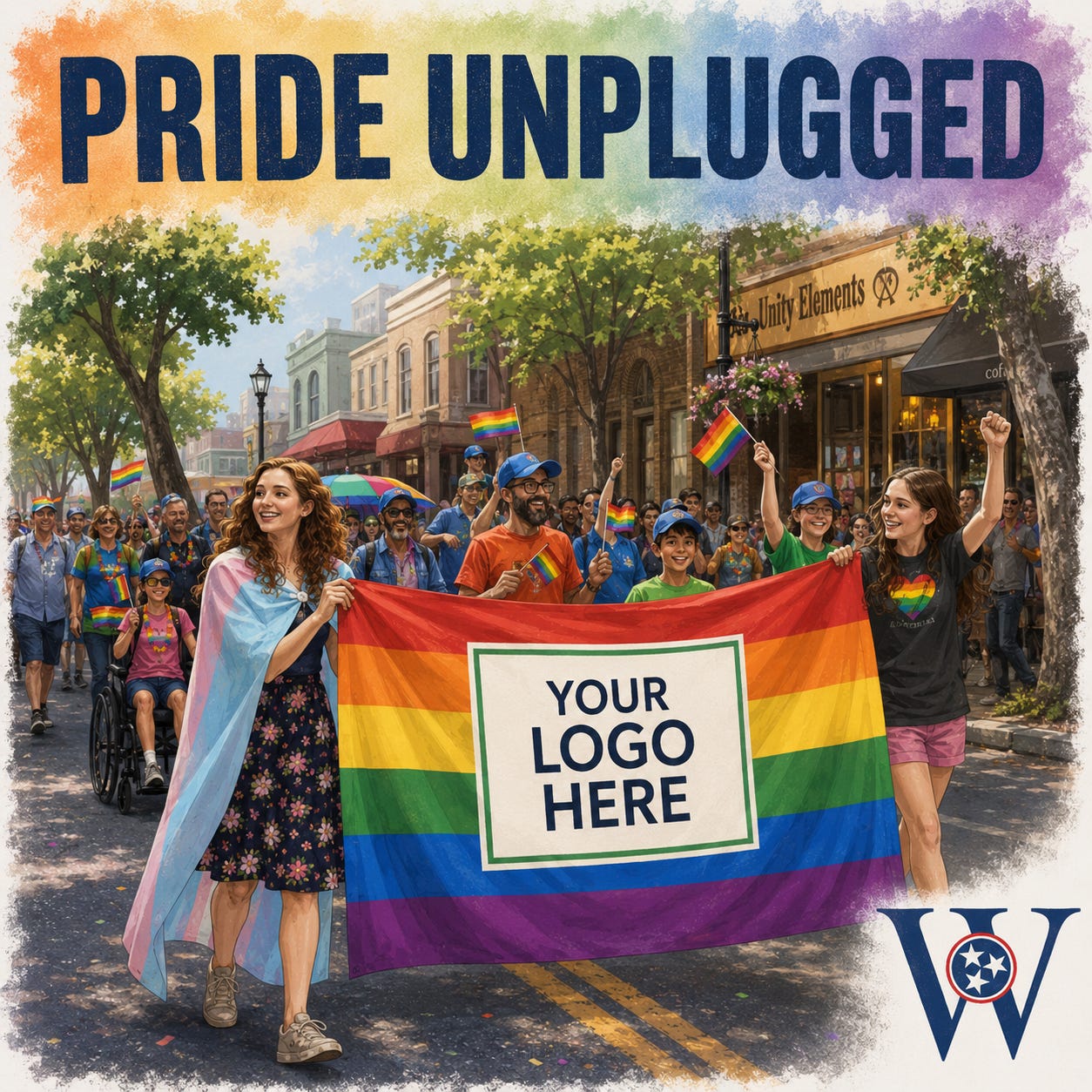
💸 CASH ME OUTSIDE, PRIDE: WHEN THE LOGOS LEFT THE PARADE
THE BANNERS CAME DOWN, AND THE BILLS CAME DUE
Last year, there were murmurs — a sponsor here, a budget squeeze there. This year, it’s a moving van backing up to the curb.
Tennessee’s Pride festivals lost a big chunk of their corporate money. Nashville Pride shed about 40% of its sponsorship dollars in 2025 — roughly $270,000 — while Franklin did worse by percentage, down around 70%, biggest sponsor and all. The household names that bankrolled these events for years are walking, and nobody seems especially eager to chase them.
Before anybody gets ahead of the facts, though: this is not the obituary for Pride festivals. They don't appear to be going anywhere. Nashville's is happening. Franklin's is still slated for Harlinsdale Farm. The festivities might be leaner, with fewer balloons per capita — but whether that's a short-term trim or the new permanent haircut isn't something anybody can honestly call yet.
The way these things get paid for has flipped. The story isn't that the money dried up. It's where the new money came from.
For years, Tennessee's biggest Pride events ran on corporate cash. Household-name sponsors. Logos on the program. A bank here, a carmaker there, a whiskey label, a discount retailer — each buying a banner and a booth, and a tidy serving of goodwill to go with it. For that stretch, Pride was an extremely safe place for a marketing department to be seen.
Then it wasn't, and the exits got crowded. Last year, Vanderbilt University Medical Center pulled out of Nashville Pride weeks before the festival. Nissan, a presenting sponsor four years running, declined to renew. Dollar General, in for at least seven years, found the door. Cracker Barrel and Jack Daniel's, gone. Bridgestone came back, but quietly demoted itself to a cheaper tier.
Most of that happened in the final 30 days before showtime — which is a fun time to discover your budget has a hole in it. The organization called it the worst financial crisis in its 35-year history.
And Franklin? Smaller for sure. But Franklin isn’t just another Pride festival. It’s a Williamson County event held in one of the most politically engaged communities in Tennessee, operating under the shadow of years of local debate over drag performances, park access, and litigation still rattling around the courts.
However they left, the companies that explained themselves gave a tell: not one said a word about values. Nissan called it a review of marketing spend to "maximize efficiency." That became the script everywhere — budget discipline, strategic recalibration, nothing ideological here, folks.
And in some corners nationally, companies kept giving but asked to do it without the logo, as “silent partners.” Which is a wonderfully corporate way of saying: we still support you, just please don’t tell anyone.
So why did so many bolt at once? Pick a theory — several are on the menu, and they’re not mutually exclusive. There are other theories available as well, but they require more tinfoil than this article’s budget allows.
—
THEORY ONE: THE TRUMP EFFECT
An April 2025 Gravity Research poll found that roughly two in five brand executives planned to pull back on Pride engagement that year — up from just 9% the year before. That's not a slow drift; that's a stampede. And the timing wasn't subtle. In January 2025, a Trump executive order directed every federal agency to draw up a list of up to nine major corporations to investigate over their diversity programs, and lawyers were openly telling Fortune 500 clients to expect to be targeted. A strong majority of the executives cutting back cited exactly that — fear of federal backlash and the broader retreat from DEI. The corporate translation of "we'd rather not end up on a list" is, apparently, "maximizing efficiency."
—
THEORY TWO: THE BEER LESSON
The Bud Light backlash didn't invent the corporate retreat so much as hand every marketing department a laminated card showing exactly what the downside looked like. One Mulvaney partnership, a conservative boycott, and Bud Light lost its spot as America's best-selling beer for the first time in two decades — a title it had held since 2001 and still hasn't won back. Nobody wanted to be the next case study. Principles, it turned out, came with a sunset clause nobody noticed at signing.
—
THEORY THREE: WE’RE FULL, THANKS
Maybe the audience finally got tired of being marketed to.
A January 2025 Pew Research Center survey of nearly 4,000 gay and transgender adults found that 68% believed companies promote Pride mainly because it’s good for business — and only 16% thought the companies actually meant it. Among those under 30, the skepticism ran hotter still: more than half said only a few companies, or none, were sincere about it. The audience the whole spectacle was built for had already read it as a sales pitch.
So when the logos came down, the reaction from the intended recipients wasn’t heartbreak so much as a knowing nod. Hard to mourn a gesture nobody believed was sincere in the first place.
To be fair, the same Pew data show those consumers still notice who stays and who runs, and other surveys find a healthy majority say they’ll reward the brands that hold the line and punish the ones that bolt. So “everybody saw through it” and “people still keep score” can both be true.
—
THE NEW MONEY
When the corporate checks stopped clearing, a funny thing happened. The events didn’t fold. Somebody else picked up the tab — and that somebody is a different animal entirely.
Nashville Pride ran a “Save Nashville Pride” emergency donor drive and pulled in about $145,000 from nearly a thousand individual donors — enough to keep 2026 alive, although short of the $250,000 goal. Which is encouraging, though “we’ll just crowdfund it” is generally considered a more reliable business model for a Kickstarter than an annual civic event. But here we are.
The Tennessee Pride Chamber Foundation ran its biggest-ever grant cycle, seeding festivals across the state with “micro-grants.” Bigger regional philanthropy rolled in behind it, including a nearly $2 million round of grants from the Laughing Gull Foundation to gay and transgender groups across the South — Nashville among them.
The money used to come from corporations making a bet on brand safety — a bet that customers never fully believed and executives eventually abandoned. Now it comes from individual donors, advocacy foundations, and movement nonprofits — money that shows up for the cause rather than in spite of the risk. The check still clears. But the name on it, and the reason it got written, are a completely different proposition.
That’s no small thing. Corporate sponsorship, whatever you make of it, was broad and arm’s-length — a company renting a little cultural cachet. Grant-and-donor money from mission-driven outfits is narrower and committed by design. So the events drift closer to the advocacy world, which now foots the bill, and further from the sort of thing a neutral local employer slaps a logo on between the United Way drive and the company picnic. It’s a significant change.
It’s also a lot less predictable. Corporate sponsorships renew on autopilot — or they did. The new model runs on motivated people showing up at the right moment. Inspiring? Sure. Nerve-wracking? Also yes. Twin Cities Pride lost a $50,000 Target sponsorship and replaced it with an $89,000 crowdfund in under 24 hours, proving it can be done. Whether donors keep that energy up in year two or year five, with no crisis to rally against, is the question every organizer now gets to sleep on.
—
THE TENNESSEE REALITY
This April, Governor Bill Lee signed a resolution naming June 2026 “Nuclear Family Month,” defining the family as one husband, one wife, and children, and billing it as “God’s design.” It bans and enforces nothing — it’s a resolution, not a law — but it does claim the same square on the calendar with the opposite message, and it cleared the House 72–18.
The pressure isn’t only coming from the statehouse. As Franklin Pride approaches, a local group has been circulating an “urgent call to prayer,” summoning people to Harlinsdale Farm to pray on the sidewalk and around the property during the festival — casting the event as a desecration of the farm’s legacy, among other claims. Down in Franklin there’s also Cocchini v. City of Franklin, the First Amendment suit over evangelists removed from the 2023 festival, still kicking around on appeal.
None of that explains the corporate pullback. But it’s the weather these Tennessee events are working in.
Strip all that away, and what’s clearly ending is the era of corporate logos stamped on these festivals — replaced by a model built on grants and individual donors, organized mostly through the openly aligned advocacy world. Whether the new model holds, nobody can honestly say just yet.
The real surprise wasn’t that the logos left. It was discovering the festivals could survive without them. Maybe the lesson isn’t about Pride at all. Maybe it’s that corporations make awkward custodians of cultural causes. They’re built to sell products, not convictions.
The moment those two goals diverge, the spreadsheet usually wins.